 Sofia Marchetti
Euronews
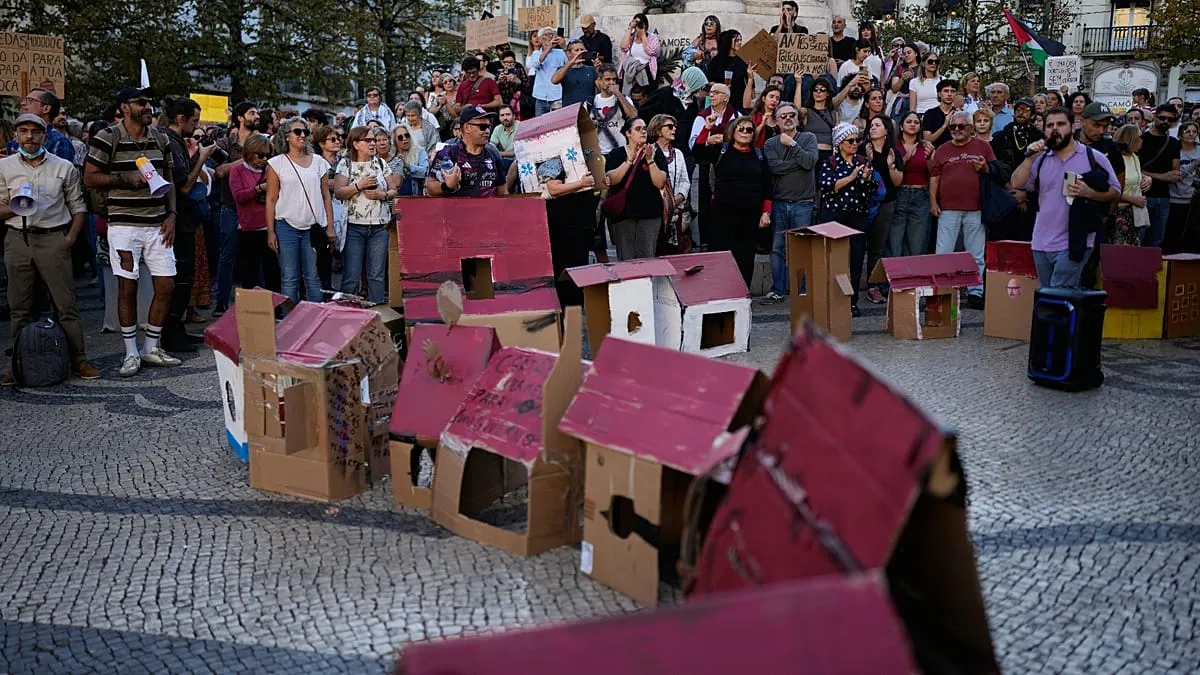
Protesters took to the streets in dozens of Portuguese cities on Saturday to demand action on the housing shortage, calling for rent caps, stronger tenant protections and a bigger public housing stock.
Thousands of people turned out across Portugal on Saturday for nationwide demonstrations against soaring housing costs and wages that have failed to keep pace, under the slogan "they will not steal our right to live here."
Crowds marched in Lisbon and dozens of other cities, pressing for caps on rent increases, better safeguards against evictions, more social housing and steps to rein in property speculation.
"We need homes to live in, not homes to speculate on. Public housing needs to be built and the price of rents needs to come down," Raquel Ferreira, of the housing-rights group Casa Para Viver, told local media as the demonstration got under way in Porto.
The rallies follow the government's adoption of a new bill that would speed up and simplify the process for landlords to evict tenants.
"What should happen, and what this massive mobilisation across the country is demanding, is the withdrawal of this draft law," said José Manuel Pureza, coordinator of the Left Bloc.
The new housing bill includes measures that could make the crisis worse
The draft legislation aims to help landlords recover rented properties more easily by accelerating eviction procedures.
It would also loosen rent controls, giving owners more room to set prices, let them ask for larger upfront sums such as deposits and advance rent, and revise the rules covering older leases signed before 1990.
Ministers say the changes will persuade landlords to bring more homes onto the rental market. Casa Para Viver disagrees, arguing tenants will be left more exposed, and wants rent regulation tied to what people actually earn.
The group criticised the government for treating €2,300 as a "moderate" income when "more than half the people working in this country earn less than 1,000 euros."
Properties valued at up to €660,000 are now also classed as "moderate" value on the housing market.
"The government and the parties that have allowed these measures to pass are pushing prices up and normalising the absurd, while rewarding landlords, developers and property funds," the organisation wrote in March.
Portugal records the third largest rise in housing costs in Europe
House prices measured against incomes climbed 60.8% in Portugal between 2015 and 2025, according to EU data — far ahead of the Netherlands, which ranked second at 34.3%.
Lisbon and Porto saw the steepest increases.
Between the first quarter of last year and the first quarter of 2026, prices rose by almost 20%, the National Statistics Institute (INE) reported at the end of October.
Rents have jumped too, up 68% since 2020, according to the government.
Economist Mike Langen told Euronews Business that Portugal "experienced a tourism boom, and their golden visa program attracted foreign investors, so house prices grew partly because of foreign capital".
Overseas buyers and investment funds pushed prices higher by purchasing Portuguese property, including buildings in poor condition.
Casa Para Viver now wants the government to act against property speculation and is calling for an end to golden visas, incentives for digital nomads and tax exemptions for property funds.
The country's mild climate and long coastline have made it a draw for digital nomads, other remote workers and retirees from abroad.
Tourism has surged as well, with many city-centre flats converted into short-term rentals and pulled out of the long-term market.
Portuguese people excluded from the property market
The average salary in Portugal is around €2,200 a month, according to official statistics.
A one-bedroom flat in central Lisbon typically costs at least €1,100, property agents say.
For many households, one income no longer covers the rent on a family-sized flat in the centre of a big city.
A report from the Deutsche Bank Research Institute (DBRI) defines disposable income as what is left of a household's net monthly salary once rent is paid. Across the 28 European cities studied, that figure ranges from €253 in Lisbon to €9,140 in Zurich.
The report also found that Lisbon and Milan are the toughest cities for couples to live in.
Lisbon residents say high prices are shutting them out of the market. On average, households in the city have just €253 left for the month after rent. Net pay in Lisbon is €1,408, but rent can reach €2,561 a month, the DBRI concludes.
Young people say they cannot get a foot on the property ladder, while parents worry their children will have to move far away to find a home. At the same time, some Portuguese homeowners have made substantial profits from selling up.
The government is trying to tackle the crisis with measures including tax cuts on new builds, restrictions on short-term rentals and a pledge to build 145,000 new homes — though it concedes the effects will not be felt immediately.
Source: euronews.com