 Elena Kowalska
Just three of the incidents catalogued by Europe's main tech industry body have been tied to a perpetrator — and that uncertainty may be the attackers' most effective tool.
On 2 and 3 November, freezers in supermarkets across Europe began flipping themselves into defrost mode. In certain stores, the temperature was pushed as high as 50°C.

Stores in Germany, Italy, the Netherlands, Belgium, Romania and Sweden binned spoiled meat and frozen goods. Several blood banks in France were affected as well. The UK also reported attacks.
EU food and agriculture commissioner Christophe Hansen described it as a "deliberate attempt to disrupt our food supply chain". Almost three weeks on, no one has come forward to claim it, and the motive is still unknown.
Sixteen incidents in one month
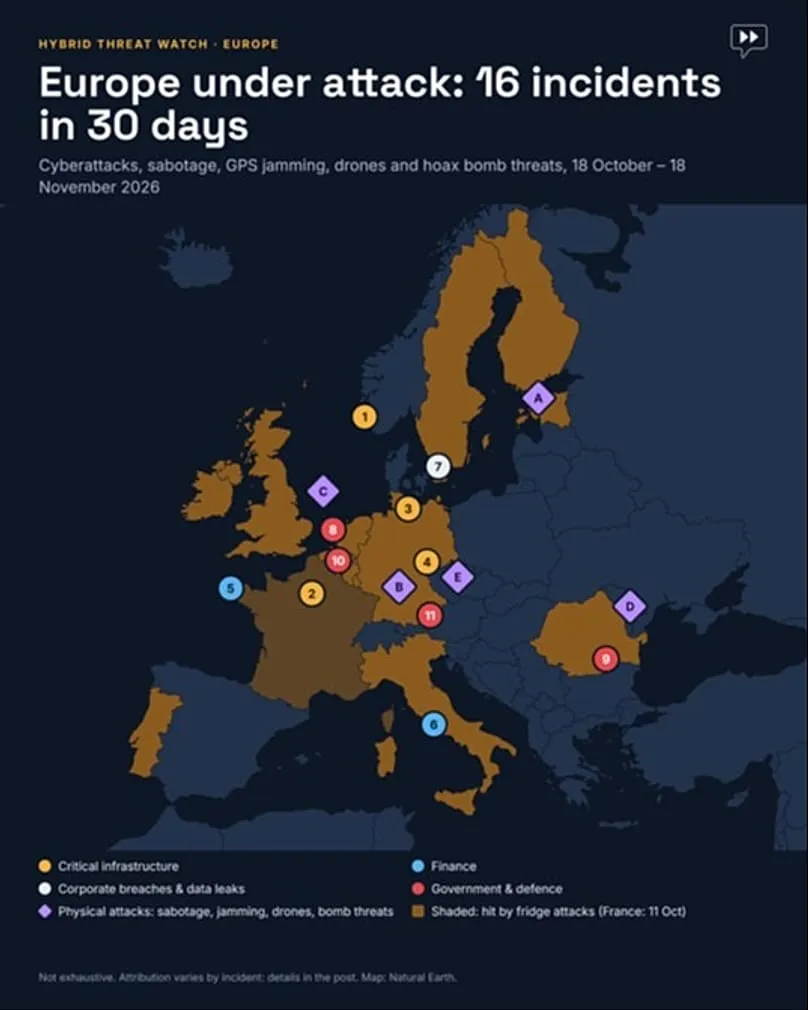
The freezer campaign was among 16 incidents charted by DigitalEurope, the Brussels-based trade association for the continent's digital technology sector, between 18 October and 18 November.
Eleven were cyberattacks. Hackers seized an energy company's IT systems in Norway, shut a district hospital's emergency room in Germany and lifted data from a tunnel contractor operating in Denmark and Germany.
At an EU institution that was not named, HR, payroll and medical systems went down. Personal details of 18 senior officials from Italy, Germany and the Netherlands were dumped online, and espionage malware turned up in Romanian government email.
Roughly €100 million was drained from a French bank via one of its suppliers. More than 700 fintech customer accounts were exposed in Italy, and a Danish shipping group's legacy system was raided for data.
The remaining five were physical, including two sabotage plots. Around 80 aircraft lost GPS over the North Sea, drones forced Moldova to shut its airspace, and hoax bomb threats struck more than 35 flights across Europe.
"Resilience is no longer just an IT department job," said Cecilia Bonefeld-Dahl, DigitalEurope's director general. "It is security policy and industrial policy."
The group stresses the list is not exhaustive. Ransomware crews alone name dozens of European victims each month.
The password is 12345
November's wave was not the first. In mid-October, hackers took control of refrigeration units in at least 350 French supermarkets — Carrefour, Monoprix, Intermarché and Coopérative U among them — and overrode their temperatures by hand.
France's cybersecurity agency said the units ran software from Danish firm Danfoss alongside Copeland and Dixell systems. Danfoss said many had reached end of life, no longer got security updates or were running outdated firmware.
Supermarket refrigeration is frequently online so contractors can monitor and fix it remotely. Security firm Forescout found almost 13,000 refrigeration control services openly reachable on the internet across 99 countries.
In November, attackers exploited weak security and known flaws in Danfoss's AK-SM system manager. Plenty of systems still relied on factory-default logins such as "Supervisor" and "12345".
George Nott, technology editor at trade magazine The Grocer, said the attackers found exposed login pages and used vulnerabilities that had already been patched. In Sweden, the Coop chain said equipment in its seven affected shops was connected over old 4G mobile networks.
Xavier Bellekens, chief executive of cybersecurity firm Lupovis, said routing the controllers through VPNs would have removed most of the risk.
Who did it?
Seven of DigitalEurope's 16 incidents have no named culprit. Attackers claimed four themselves. Investigators suspect an actor in two cases without formally naming it. Only three have been publicly attributed by a government or researchers.
"That is what makes hybrid attacks work: cheap, deniable and hard to pin on anyone," the group said.
The freezer attacks show how difficult the question is. Lupovis said its decoy systems logged more than 276 attempts by 91 threat actors to probe Danfoss controllers over 10 days, peaking on 26 October and stopping at the end of the month.
The activity was traced to "bulletproof hosting" services built to resist takedowns and law enforcement — some of which Russian groups have used before. Bellekens said that did not prove Russia was behind it, but there was "a bit of a pattern". The coordination within roughly 24 hours pointed to a well-planned operation, possibly state-run, he added.
Others are not convinced. Dan Cimpean, director of Romania's National Cyber Security Directorate, called the attacks "semi-amateurish" and said he did not suspect a state actor. After the French attack, Ken Munro of British firm Pen Test Partners said it could be "kids messing around".
No ransom was demanded, which investigators found odd: criminal and hacktivist groups usually move fast to profit from or publicise an attack. Agencies cannot even settle on what to call it. Belgium, Italy and Estonia labelled it a cyberattack; Sweden and Ireland a "cyber incident"; the EU's cybersecurity agency ENISA stopped short of calling it an attack.
Same targets, different weapons
DigitalEurope's tally suggests the boundary between online and offline attacks is fading. In the same month, one German military drone maker was hit through a hijacked software update, while an arson attack on another in Estonia was thwarted.
The group also counted a plot to start fires beside a railway and a power line in Germany.
"Digital and physical attacks hit the same targets," it said. Its map shows incidents stretching from the North Sea to Romania and Moldova.
Find, fund, buy
Bonefeld-Dahl wants Europe to go further. "Europe needs the technology to detect, deter and recover – and it must FIND. FUND. BUY," she wrote on LinkedIn.
DigitalEurope is urging EU leaders to commit at least 25% of the next EU budget — worth almost €2 trillion — to technologies for deterrence, defence and recovery. It says only 14% currently goes to digital.
"There is no more time to waste," Bonefeld-Dahl wrote, in a message addressed to the bloc's prime ministers.
The 14% figure is the digital share of the EU's 2021–2025 spending, including its post-pandemic recovery fund, rather than of the budget now under negotiation. And as an industry lobby, DigitalEurope speaks for many of the companies that would sell Europe that technology.
In Brussels, the response is taking shape in the revision of the EU's Cybersecurity Act, led in the European Parliament by Czech MEP Markéta Gregorová.
What next?
Experts warn fridges are only the beginning. Nott said heating, ventilation and air conditioning systems, electronic shelf labels and even floor-cleaning robots could carry similar weaknesses.
Those same controllers can operate doors, access systems, cameras, alarms and climate equipment, according to Kumar Sokka, chief executive of Acre Security. Too often, he added, companies hand them to facilities staff and forget that NIS2, the EU's cybersecurity law, covers them too.
AI may sharpen the threat. Gianni Cuozzo, founder and chief executive of Exein, argued that AI is compressing the gap between spotting a flaw and weaponising it. Connected devices, in his view, have to defend themselves while they run.
Bonefeld-Dahl takes the debate to Vilnius, Lithuania, next week. Her parting line was a question: "What's the next critical target?"
Read more

Actor Ashton Kutcher enters billionaires club as Anthropic floats

How long does an El Niño last? Forecasters warn 2027 won't be immune
Hackers leak data on 16,000 Visa, Mastercard & JPMorgan customers
- Cyber attack
- cyber security
- Digital Economy
Source: euronews.com