 James Okafor
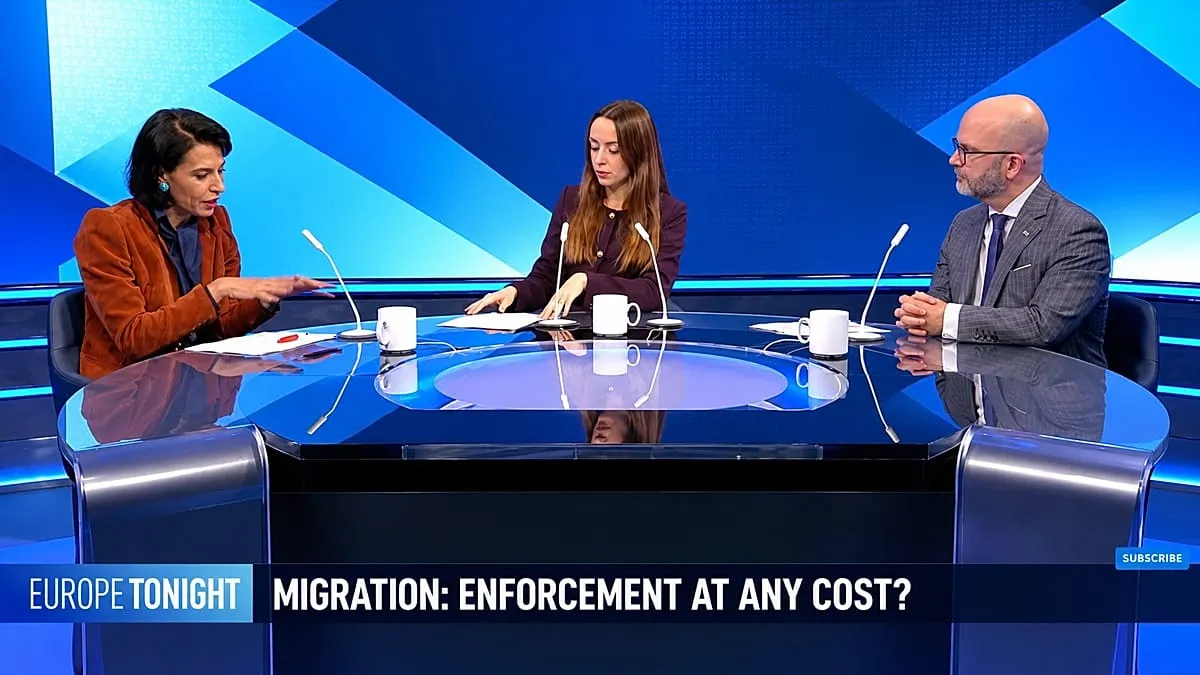
On the debut edition of Euronews' Europe Tonight, presenter Mared Gwyn Jones chaired a discussion on Europe's newest migration crackdown, following an announcement by five EU member states of a partnership with Rwanda to set up deportation hubs for irregular migrants.
Euronews' new flagship programme, Europe Tonight, aired its first episode with presenter Mared Gwyn Jones guiding viewers through the weekend and Monday's biggest stories.
Jones led the programme with migration, after Greece, Denmark, Germany, Austria and the Netherlands revealed a joint partnership with Rwanda to create deportation hubs for irregular migrants. The first pilot centres are slated to be up and running by mid-2027.
Correspondent Vincenzo Genovese, reporting from Vienna, described the move as unprecedented in EU migration policy: the bloc would send irregular migrants to a country they have no prior ties to — an approach that has drawn comparisons with Donald Trump's policies in the US.
Danish Prime Minister Mette Frederiksen called the agreement a "game changer," arguing it would help European countries regain control and remove the pull factors that drive illegal migration.
Sources close to the negotiations say the first facility will house around 100 people. It will operate as an open facility rather than a closed detention centre, and migrants will be free to move around the country. The aim is to give them a chance to integrate into local society and the labour market.
Under the EU law permitting return hubs outside the bloc, only non-EU countries "where international human rights standards are respected" qualify.
Rwanda's human rights record has drawn scrutiny. Still, the country's interior minister, Vincent Biruta, insisted Rwanda was ready, had solid experience handling migrants and would uphold fundamental rights.
Legal fights could erupt once deportations begin next year — much as they did with the UK-Rwanda deal.
On Monday, Frederiksen said she had a strong hunch that more countries would sign up.
Nineteen of the EU's twenty-seven governments back the deportation plan. Only France and Spain have clearly stated their opposition. Italy already has its own arrangement with Albania.
THE DEBATE
MEPs Charlie Weimers and Abir Al-Sahlani discuss Rwanda
Jones was joined by Swedish MEP Charlie Weimers, a member of the European Parliament since 2019 with the European Conservatives and Reformists group, and Iraqi-born Swedish MEP Abir Al-Sahlani of Renew Europe, also an MEP since 2019, to debate the Rwanda "Return Hub."
Weimers backed Frederiksen's assessment, calling the policy a "game changer." He noted that "every system" starts small and said it would count as a success if it paved the way for further steps on EU migration policy down the line.
Al-Sahlani raised doubts about whether Rwanda could actually return migrants to their countries of origin, asking how it would manage that when European countries themselves had struggled.
“If we in Europe were not able to send them back to their countries, what makes us believe Rwanda will be able to?” Al-Sahlani asked, pointing to Rwanda's reliance on development aid, security concerns and other unresolved questions.
Weimers calls deal a 'deterrent'
Jones pressed Weimers on whether the proposed centres would be worth the money, citing Italy's Albania scheme: it costs Italian taxpayers €670 million over five years while processing just 0.3% of illegal arrivals into Italy. Weimers said the new deal was meant to act as a "deterrent" for anyone thinking of migrating to Europe illegally.
Al-Sahlani also took aim at the growing sway of far-right narratives over European migration policy, arguing that governments were failing to make proper use of existing legislation and tools.
The Renew Europe MEP went on to accuse political leaders of casting refugees as a threat and turning them into scapegoats for broader societal problems. She warned that migration debates were increasingly shaped by emotion rather than facts, driven by misused statistics, selective truths and invented stories that demonise people seeking refuge.
Don't forget to join us tomorrow at 6 p.m. for the latest analysis of Europe's top headlines.
Source: euronews.com