 Lucas Moreau
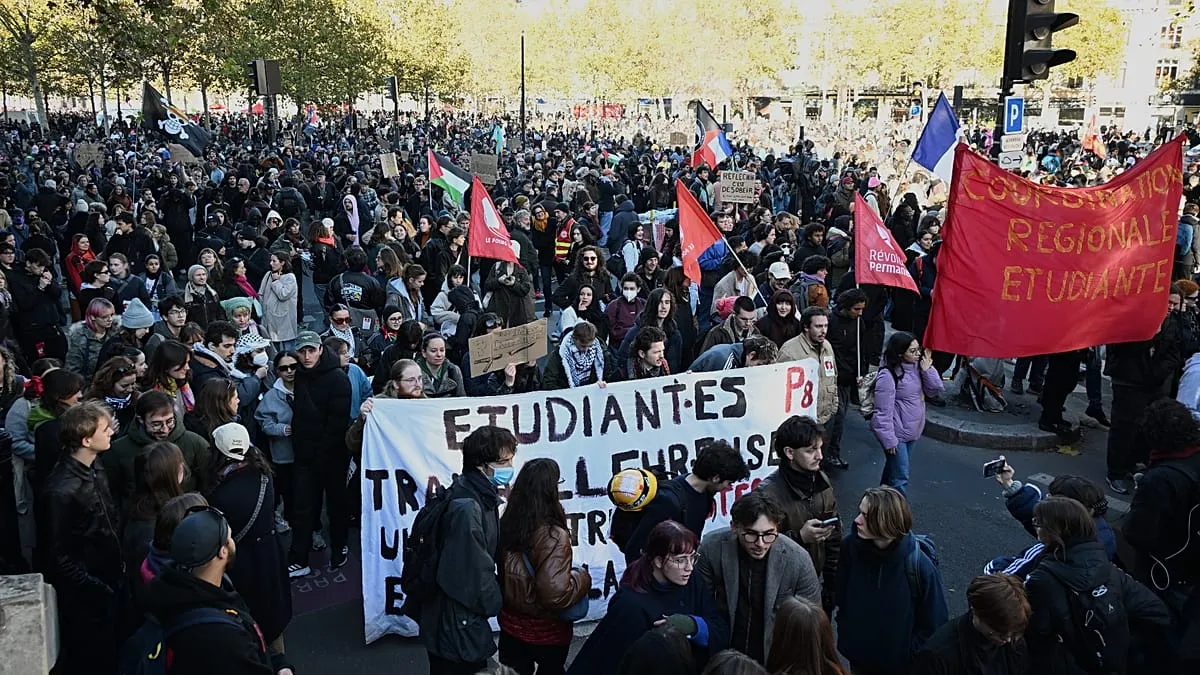
Yellow vests, students and education unions marched to air a long list of grievances — the rising cost of living, demands for better school funding, stronger safeguards for children and teenagers, and a new police law.
Thousands of people demonstrated in towns and cities across France on Saturday. It was the fifth weekend in a row that nationwide protests have been held.
Yellow vests, students and education unions all joined the marches. Their complaints ranged from the rising cost of living and calls for more money for schools to stronger protection for children and teenagers, along with opposition to a new police bill.
In Paris, a large crowd assembled on the Place de la Republique, long a symbolic meeting point for protests across the country.
"We're asking to have teachers when we go to class. We're asking to not have ceilings collapsing on us when we eat in the canteen. We're asking, when we get our A-levels, despite conditions getting worse every year, to be able to carry on our studies at university," said Marius Mesnil, co-secretary-general of the Union Syndicale Lycéenne.
School blockades and demonstrations have shaken France for over a month.
The interior ministry put Saturday's nationwide turnout at about 106,000, including 24,000 in Paris. Organisers counted 200,000, with 100,000 of them in the capital.
Saturday's crowds were smaller than usual. The biggest protest in recent weeks came on Thursday, during a strike called by the unions, when more than half a million people marched across the country.
Unions have called another day of strike action for next Tuesday. They rejected the government's promise of a 0.6% rise in the minimum wage, saying it falls far short.
"The government has only given us crumbs, and we want the whole bakery," said Benjamin Ball, a member of the Yellow Vest movement.
'Licence to kill' bill
Demonstrators also voiced opposition to a new police bill that would give police officers and gendarmes extra protection when they use firearms on duty.
Backers of the bill — among them Marine Le Pen's far-right party, currently leading the opinion polls in the presidential race — say the law is needed so that officers are not automatically presumed guilty of using excessive force.
Unions counter that the bill amounts to a "licence to kill" for police and would make it even harder to hold law enforcement officials to account. In France, allegations of police brutality seldom reach a criminal court.
"What the so-called 'licence to kill' law, which is being put to the vote next week, provides for is literally that a police officer who fires will first be presumed to have acted lawfully," said Sabrine Kharbach, spokesperson for the Student Union.
"Yet another layer of impunity for those who club us, gas us and maim us. Yet another layer of impunity for this police force that acts as the armed wing of the state," she added.
Kenza, 28, was among the thousands of demonstrators on the streets of Toulouse in southern France. "The repression of protesters is unacceptable, especially when children are involved."
Last week, lawyers for at least 18 people injured at protests in France in recent weeks said they would sue the interior ministry over its responsibility for alleged police brutality, according to local media.
They condemned police use of force at the demonstrations, which they said had caused "mutilations," including injuries to protesters' hands, feet and eyes.
Source: euronews.com