 Elena Kowalska
Where content comes from: building it, buying it, or a bit of both
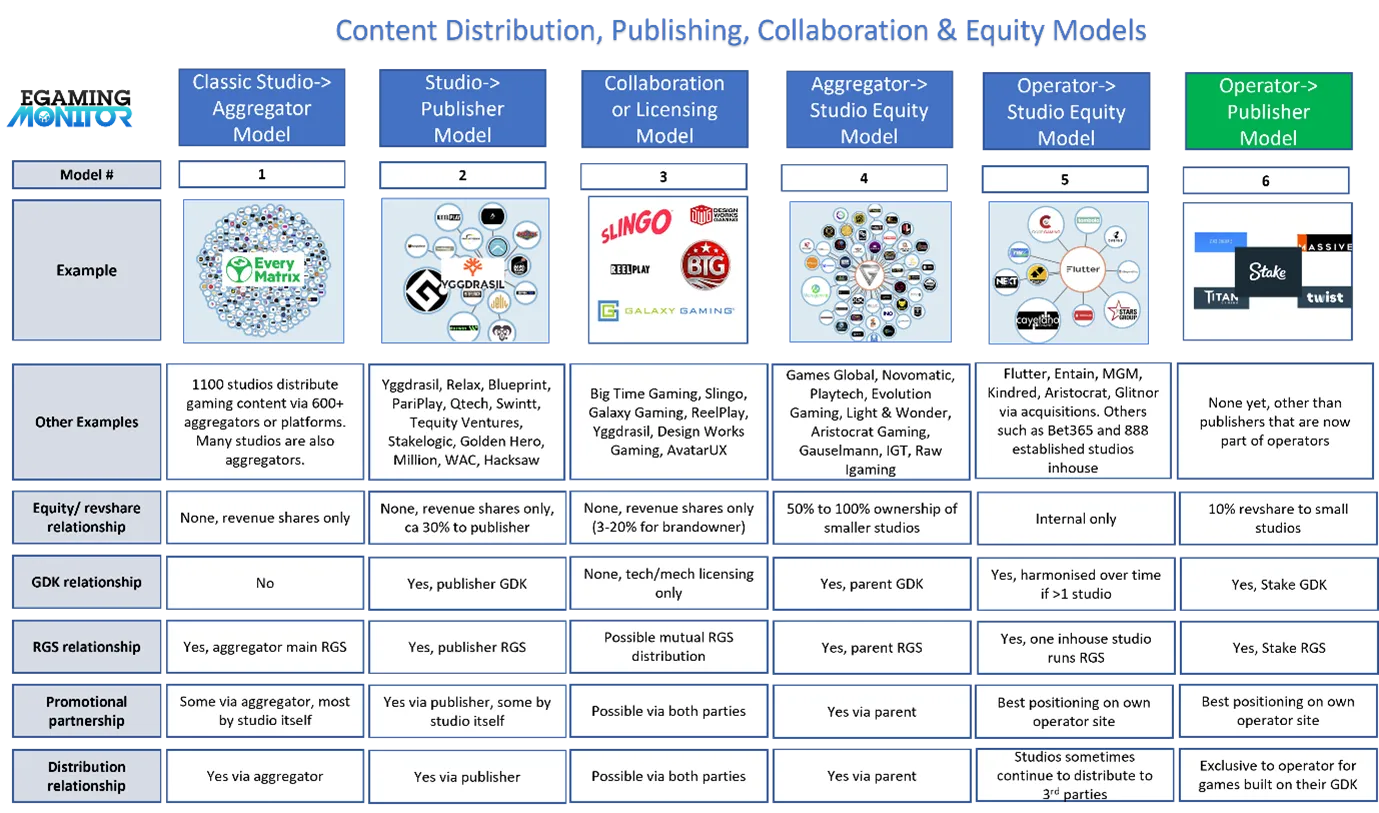
Stake shook off Brexit and launched something the sector hadn't seen before last month: Stake Engine, a publisher service run by an operator rather than a supplier. Studios can build games and push them live on the site directly through Stake's GDK/RGS — model number 6 in the list above.
The classic publisher model (number 2 above) has been around a while. Yggdrasil broke ground on it with Masters Academy, and Relax, Pariplay, Light & Wonder and Swintt followed with programmes of their own. Stakelogic, WAC, Tequity, Qtech and Blueprint have all tried their hand at it too. The newest suppliers to back the approach are Million Games, Barbara Bang and Hacksaw Gaming. A rundown of supplier-run publisher programmes sits below.
In-house studios (model 5) aren't a new idea either — most of the bigger groups develop at least some content themselves. Stake, for its part, turns out a slate of Stake Originals, largely crypto-flavoured titles like Mines, Crash and Limbo.
With Yggdrasil, Pariplay and Relax now sitting inside operator/supplier groups, you could argue the operator-publisher model already exists in all but name. What sets Stake's programme apart is that it comes from an operator first, not an aggregator.
The point is to give smaller studios a foothold they'd otherwise find hard to get — and the 10% rate on offer is fair. Stake gets exclusive independent content in return, with no middleman costs (unlike models 1 and 2, for instance).
Massive, Titan and Twist are among the first brands on Stake Engine. Whether these studios are truly 'independent' is open to question, but they get the model off the ground. That means more than the 10-plus new studios we add to our database every month will be watching — some of Stake's rivals included.
For the operator, this is a quicker way to churn out large volumes of exclusive content than buying studios or building them from scratch, Stake Originals aside. And Stake has some ground to make up on the homegrown front, particularly next to certain peers.
With that in mind, here's a bit of free data from our platform comparing in-house content provision at some of the larger operators. The chart below shows how far Stake trails certain rivals on in-house content share.
* A quick caveat: dividing the number of in-house games by the number of unique games won't give you the same figure as the percentage share of in-house content, for two reasons. First, in-house games can appear on several pages, sometimes more than once on the same page. Second, the percentage share is based on how often in-house game tiles showed up across all pages during the first two weeks of May. Over that same window, some third-party games may have appeared briefly and then dropped off. In-house content tends to stick around and show up more widely.
The chart also leaves out exclusive content that studios produce and deliver through the usual integration routes.
To be clear, we're not calling it: this operator-led publisher model may go nowhere. After all, only the biggest operators can use it. Still, it's a notable twist on existing distribution models and worth keeping an eye on. Model 3 above — collaborations and mechanic licensing — was covered in an earlier article.
The casino charts
Gates of Olympus claimed the top two spots last month, and Pragmatic's 1000 editions have shown godlike ubiquity and staying power. Big Bass Bonanza 1000 enters the charts this month, beaten only by another fresh launch from the same stable, Gates Of Olympus Super Scatter. The new game pushes volatility higher again, with multipliers reaching 50,000x.
Top 20 games by distribution
We don't publish an Easter chart as such, but we can settle which came first, the bunny or the egg. Four of the five best new Easter performers this year were chicken-themed:
Industry deals and game distribution
Back to the classic studio → aggregator model (number 1 above), we also keep tabs on the dealmakers. Barbara Bang is the studio to watch, having recently signed several new aggregators, among them St8, Notix, Betfounders and BlueOcean.
Biggest aggregator dealmakers
Reevo (Lucky), meanwhile, is giving EveryMatrix a run for its money on aggregation, having signed 15 studio deals in the past six months.
One last free nugget while we're on the subject: the average studio works with 12 aggregators, and the average aggregator carries 21 studios. Get in touch if you want to know more.
Biggest studio dealmakers
* Some charts above run on live data, so make sure April 2025 is selected in the dropdowns to match the analysis.
** The interactive games chart excludes live games and table games. Rankings are based on how many times a game appears on the casino homepages of more than 4,000 casino sites. For many other charts — game rankings, live and table games, positions on subpages, or filtering game performance by theme, feature, market or operator — contact our partner, Egamingmonitor.com. Egamingmonitor covers 80,000 games, 1,900 suppliers and 4,000+ operators.
Source: igamingbusiness.com